Soundproofing vs Absorbing Difference

Blog
What is the difference between sound absorption and sound insulation?

There are many materials and products recommended for noise control or sound treatment. However, different materials affect sound in different ways, and it's important to know what they are good for, so you can select the best materials for your project. The biggest source of confusion is the difference between sound blocking and sound absorption. If you understand this difference, you can avoid wasting time, money, and effort on products that will not accomplish what you want.
Sound Blocking vs Sound Absorption
Sound blocking is what you want when your goal is to prevent sound from entering leaving area. This is what we normally mean when we talk about soundproofing. Examples are:
| Spesification | Sound Insulation | Sound Absorbtion |
| Goal | To prevent sound from being transmitted from one place to another. | To reduce the echo within the space. |
| Scope of Influence | Between two different volumes | Same room |
| Place of Use | Walls | Ceiling, floor, walls |
| Material Type | Heavy and multi-layered | Porous and lightweight |
| Main Objective | Noise Control | Acoustic Comfort |
Sound blocking is what you want when your goal is to prevent sound from entering leaving area. This is what we normally mean when we talk about soundproofing. Examples are:
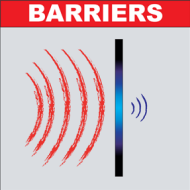
Sound absorption is what you want when the goal is to reduce the sound bouncing around inside a cabin, causing echoes and reverberations. The key is this: The source of the sound is in the same room with the listener. Examples are:
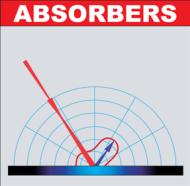
Related to sound absorption is sound diffusion. These two techniques are used in tandem to optimize the acoustics within a given space (acoustical room treatment), according to the purpose and individual characteristics of the room.
How to Tell What a Product Is Designed for
When you're looking at a potential soundproofing product, how can you tell whether it is designed for sound blocking or for acoustical room treatment? It's not always obvious from the way the material is advertised. Both types of material may be billed as noise reduction products or sound treatment products, or even as soundproofing products. Here are three ways to tell:
1. Look at the test data.
If the product specifications include a sound transmission class (STC) number, a transmission loss (TL) curve, or a weighted sound reduction index value, the product was tested as a sound blocking material.
If the specs include a noise reduction coefficient (NRC) or a weighted sound absorption coefficient, the product was tested as a sound absorbing material.
If no test data is available for the product, that means any advertising claims made for the effectiveness of the product are unsupported.
2. Look at the words used to describe the product. Although not always reliable, it can still give you a clue.
Sound blocking materials may be described as noise blockers or noise barriers, or as preventing the transmission of sound.
Descriptions of noise absorbers may discuss acoustic treatment or acoustic conditioning, for reduction, absorption, or diffusion of reflected sound, echoes, and reverberation.
3. Look at the material itself.
Panels of sound blocking material are usually quite heavy.
Noise absorbers tend to be light, soft, and/or porous.
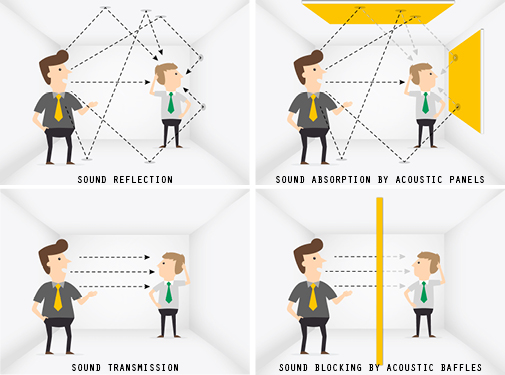
Sometimes Both Are Appropriate
Sound blocking and sound absorption applications are not mutually exclusive. For some projects, both techniques will be needed.
The Role of Absorption in Soundproofing
If you're familiar with the basic principles of soundproofing, you know that absorption is indeed one of the four basic soundproofing elements, albeit the element with the weakest effect. Does that mean that acoustic treatment products can contribute to effective soundproofing? Not quite. Here's the difference: When used for acoustic treatment, absorptive materials are installed as exposed surfaces within the room. But when used for soundproofing, the place for absorption is within a closed space such as within a wall, where standard fiberglass insulation, loosely packed, can serve to absorb sound that would otherwise get bounced between the wall panels.